Control Room rc.4: Codex, on any model, under your policies.
 Nagu Gopalakrishnan · Co-founder and CTO
· 5 min read
Vidai Control Room 1.0.0-rc.4 is out now. It brings Codex, the OpenAI Agents SDK and any app built on OpenAI's Responses API under the same governance as the rest of your organisation's AI traffic: policies, guardrails, routing, costs and request logs. Because the gateway translates between APIs in both directions, Codex can now run on Claude, Gemini, Amazon Bedrock, Vertex AI, watsonx or any Chat Completions provider, such as Qwen or Llama served through Ollama or vLLM.
The Community Edition is free. Install it in a few minutes.
What does "governance first" mean for a release like this?
We start from what your organisation has decided its AI may do, not from a model or a tool. Every AI call goes through the gateway, and a policy decides what happens to it: which models are approved, what personal data may leave, which regulation applies to which team, and what each team may spend. Every call is logged with who made it, what happened and what it cost.
We are deliberately unopinionated about everything else. We don't choose your model, your SDK or your coding agent. Teams use what they already use; the policy holds either way. rc.4 extends that to one of the fastest-growing sources of AI traffic in engineering teams: coding agents.
What is new for Codex in rc.4?
Vidai already translated in both directions between the Chat Completions, Anthropic and Gemini APIs. rc.4 adds the Responses API, which is what Codex and the OpenAI Agents SDK speak. There are two ways to use it.
A developer asks for a model. Run codex -m deepseek-flash "Fix the failing tests". The gateway translates the Responses API call for the model that was asked for, and the request log shows the model asked for and the model that answered.
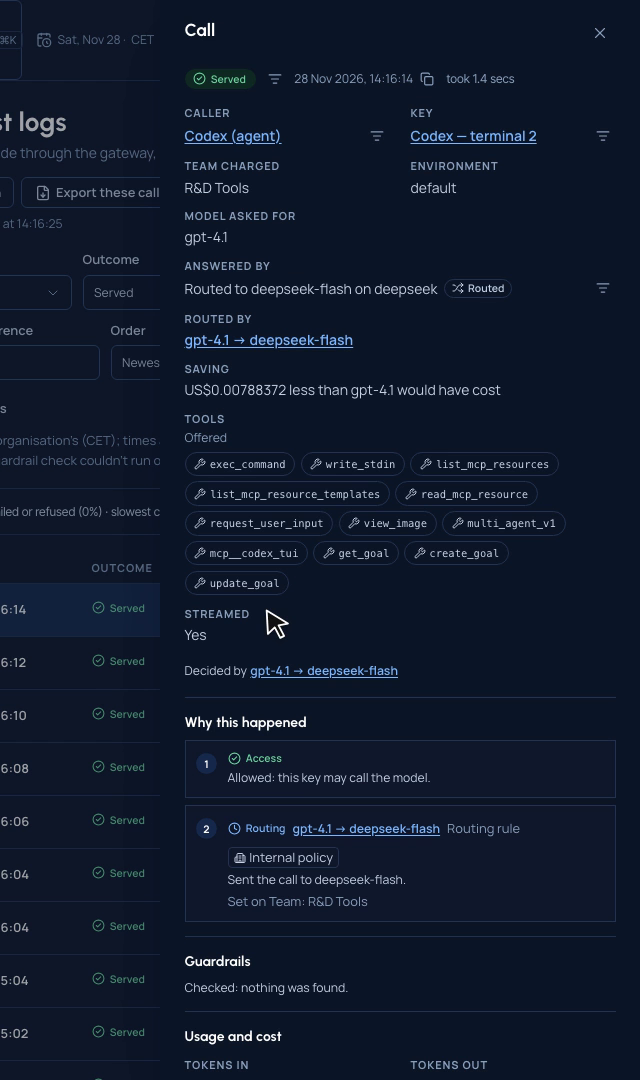
Your policy decides. Codex asks for gpt-4.1. A routing rule for one team sends those calls to a different model. The developer changes nothing. The request log records that the call was routed, which rule routed it, and the saving against the model that was asked for.
[[VIDEO 2: drop the Codex demo (case-a-choose-deepseek-split or case-b-02-vidai-routes-split) here, then delete this line]]
The translation also works the other way. Apps that use the Chat Completions, Anthropic or Gemini APIs can call OpenAI models that are only offered through the Responses API, using a new provider type, "OpenAI (Responses API only)".
| Your app speaks | It can now reach |
|---|---|
| Responses API (Codex, OpenAI Agents SDK, custom code) | Claude, Gemini, Bedrock, Vertex AI, watsonx, any Chat Completions provider |
| Chat Completions, Anthropic or Gemini API | OpenAI models offered only through the Responses API |
Streaming, tool calls, reasoning and web-search sources carry across. When something can't be translated, the response says so by name rather than dropping it silently.
Do guardrails apply to Codex calls?
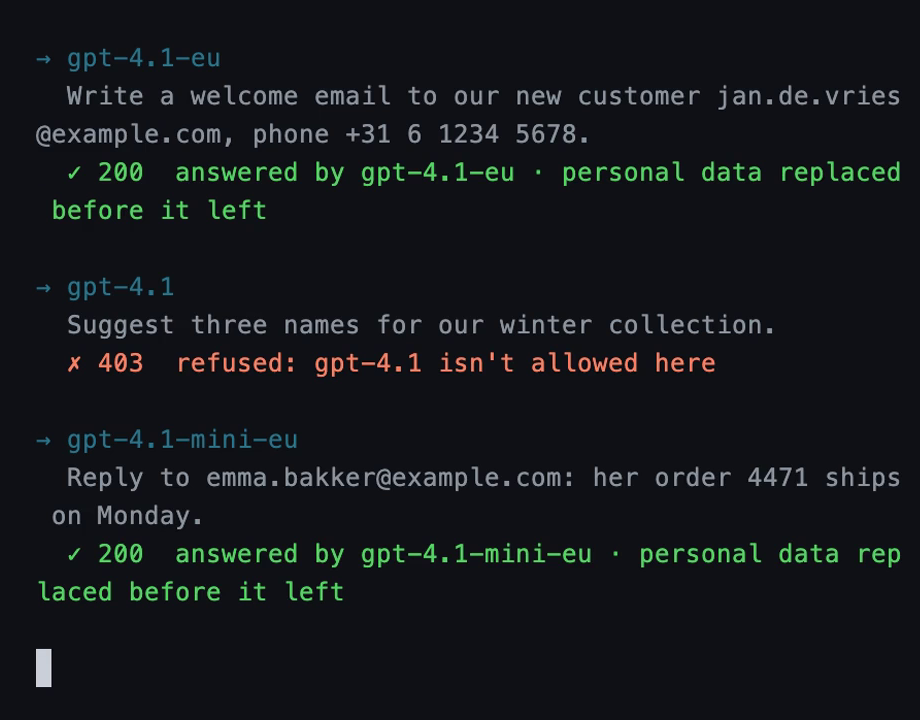
Yes. Masking, pseudonymisation, blocking and log-only rules now apply to Responses API calls, including Codex. Every part of a Responses API call passes through your model rules and guardrails, so a coding agent gets no side door around the policies your other apps already follow.
The same gateway that masks a customer's email address before it leaves, or refuses a model a team isn't allowed to use, now does the same for Codex.
What changed in policies?
Policies are now the single place to manage governance. Every guardrail, region rule and compliance route belongs to a policy.
- Start a policy from a regulation (for example GDPR for one team) or from scratch.
- Run it in Observing mode, which logs what it would do, or Enforcing mode.
- See its rules, where it overlaps with other policies and its history on one page.
- A new Library holds packs, patterns, templates and custom standards, and shows which policies use each item.
Rules created outside a policy by an earlier release are labelled "Not in a policy" and can be added with one click. Settings › Defaults can require every rule to belong to a policy.
What else is in rc.4?
- Request logs and costs. Each call shows whether the caller ended the stream early (it is still billed), whether it was a live session, whether it was translated and what changed, and whether its cost was estimated. Cost totals show how much is estimated.
- Security hardening. Pseudonymised data is unique to each installation and can't be reversed without your key. Pseudonymisation now covers embeddings and search (rerank) calls, and protection against malformed requests is stronger.
- Drift is reverted. Settings changed directly on the gateway are flagged, reverted and recorded in the audit log.
- Simpler setup. The Add provider form asks only for required fields, with the rest under Advanced.
- Fixes. One unusual request can no longer block others from being logged, and streaming is smoother across providers, including Bedrock and Vertex AI.
What are the known limits?
We would rather you hear these from us.
- Live sessions. Codex can connect over WebSockets, but live sessions don't yet support compliance controls or costing. They are off by default; an organisation admin can turn them on for the whole organisation or for individual keys, and the console shows which keys can open them.
- Full conversation per request. Codex and other Responses API apps using non-OpenAI models must send the full conversation with each request. Conversations stored on OpenAI's side aren't supported yet.
How do I try it?
rc.4 is a release candidate for public testing; 1.0.0 will follow. The Community Edition runs with Docker Compose on one host:
- Download the
vidai-community-1.0.0-rc.4.tar.gzbundle from the release page and extract it. - Run
setup.sh, thendocker compose up -d.
The install guide covers the details. The bundle and images are signed, and you can check them with cosign. Upgrading from rc.3 uses the same steps as before, with one extra command for rollback; the bundle's README has both. Version 1.0 is a fresh installation and does not upgrade 0.8 in place, so if you run 0.8, get in touch.
If you are new to Vidai, start with what the Community Edition includes, or read how the request logs map to EU AI Act Article 12 record-keeping.
FAQ
Can Codex use Claude or Gemini through Vidai? Yes. From rc.4, Codex and other Responses API apps can use Claude, Gemini, Bedrock, Vertex AI, watsonx and any Chat Completions provider through the gateway.
Do developers have to change how they use Codex? No. They can ask for a model with -m, or keep asking for the model they always use and let your routing rules decide.
Are Codex calls logged and costed? Yes, like every other call: who called, which team was charged, the model asked for, the model that answered, why, and the cost. Live sessions are the exception for now, as listed under known limits.
Is the Community Edition free? Yes. Enterprise packages for Docker and Helm are available through the Vidai contact page.